

American-made upholstery stands apart from mass-produced alternatives because of what happens before a single yard of fabric is cut. The difference lives in the hands of skilled artisans, in the density of the foam, in the species of hardwood chosen for the frame, and in the regulatory standards that govern every step of production. Here is what genuinely sets domestic upholstery apart:
- Artisanal hand labor over assembly-line production, with generational craft traditions embedded in the process
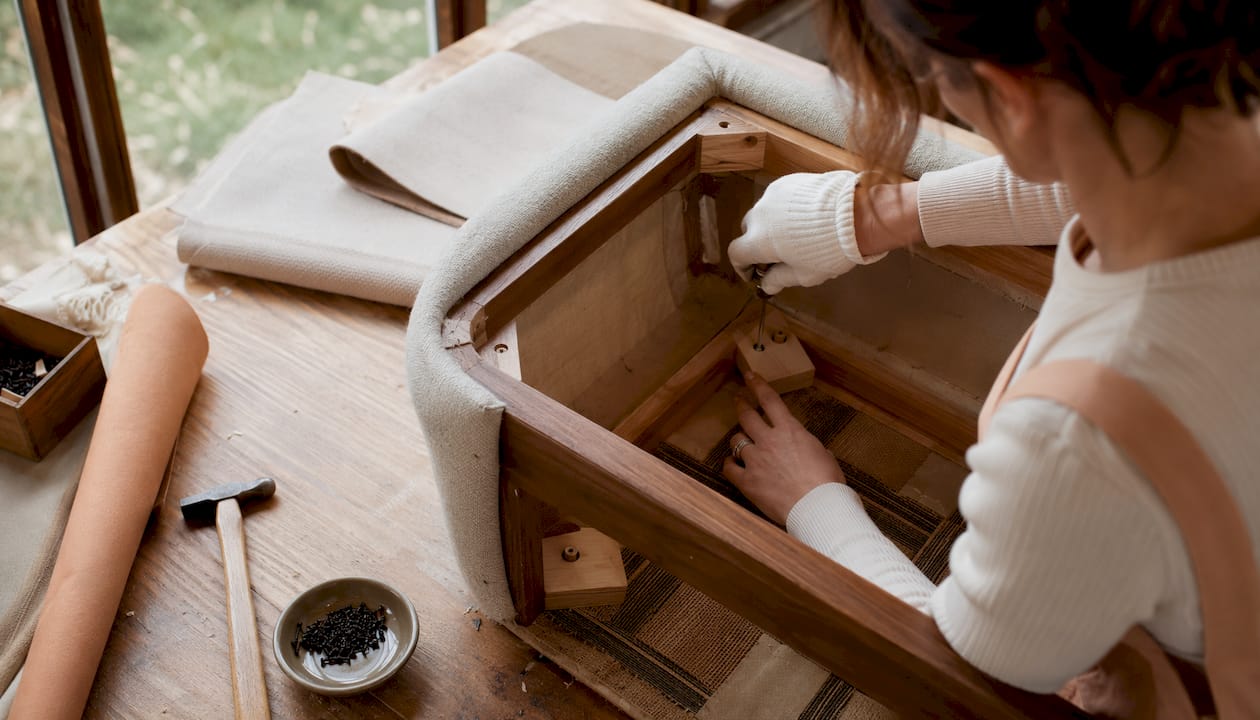
- Kiln-dried solid hardwood frames joined with glue, screws, and corner blocks rather than staples
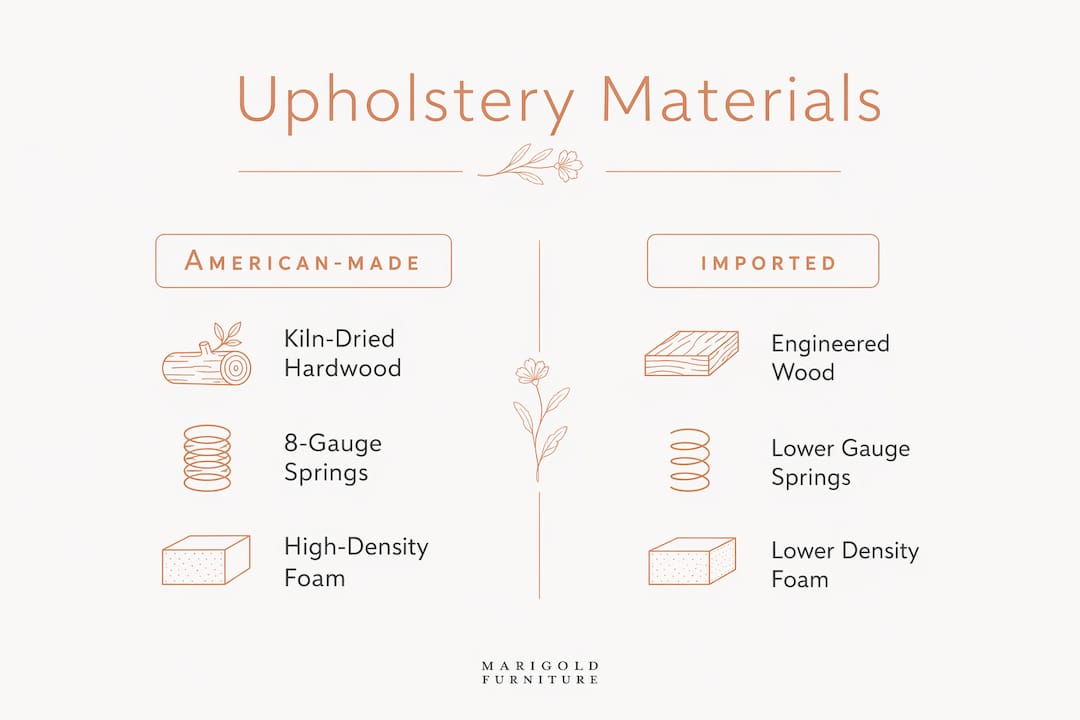
- CertiPUR-US certified foam with densities of 35–45 kg/m³, well above the 28–35 kg/m³ common in mass-market imports
- Compliance with 16 CFR Part 1640 and the updated California TB 117-2025 flammability standards.
- Shorter supply chains that enable 3–8 week lead times versus the 8–16 weeks typical of imported custom furniture
Each of these factors compounds. A kiln-dried maple frame paired with 8-gauge sinuous springs and upholstery-grade fabric does not just look better on day one. It holds its shape, its comfort, and its beauty for decades.
Why American-made upholstery differs in craftsmanship and construction
The soul of American upholstery lives in its construction methods, and those methods trace back to workshop traditions that predate mass manufacturing. Skilled upholsterers learn to read a frame the way a tailor reads a body, adjusting tension, layering materials, and hand-finishing details that a machine simply cannot replicate.
Kiln-dried solid hardwood frames with glued, screwed, and corner-block joinery outperform engineered woods and stapled frames in durability under daily use. Kiln-drying removes moisture before construction, which prevents the warping, joint loosening, and creaking that develops in green or air-dried wood as a home’s humidity shifts through the seasons. The specific species matters less than the drying method and the consistency of the grain through every structural member.
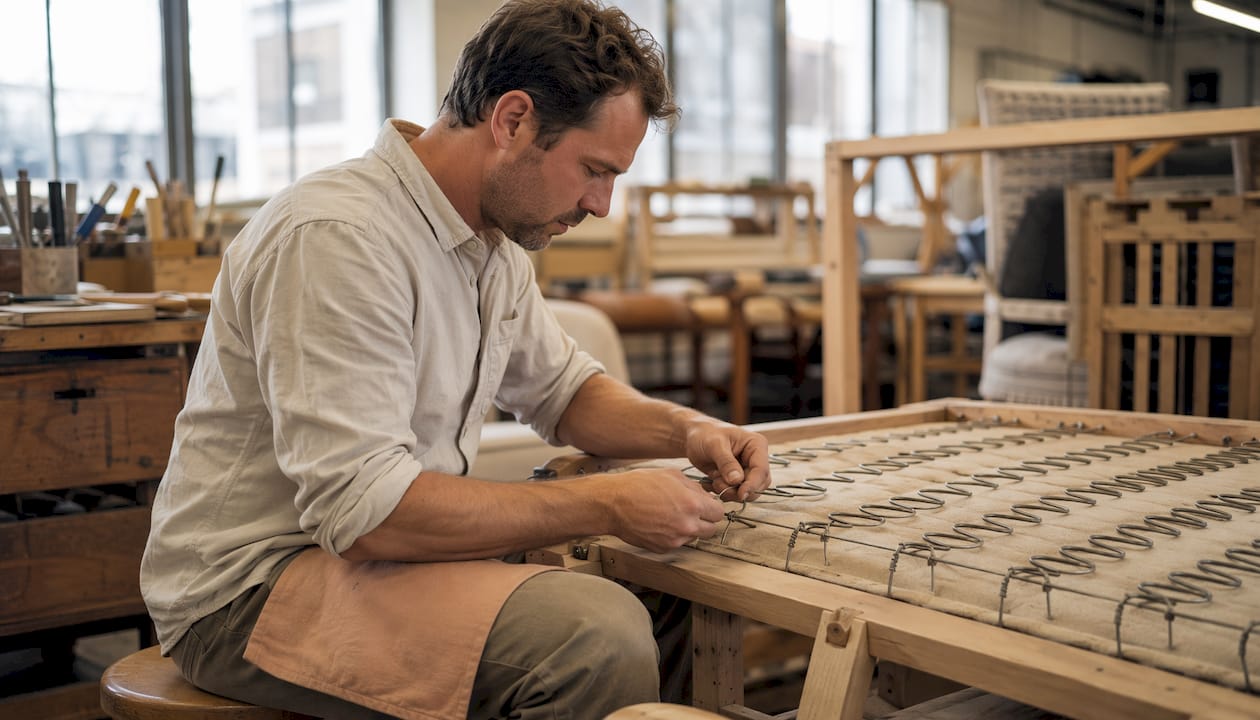
Spring systems tell an equally important story. Quality American sofas use 8-gauge sinuous springs, S-shaped steel wire attached across the frame from front to back. They distribute seated weight evenly and return to their original shape after each use. Webbing, the cheaper alternative, uses interlaced nylon or elastic straps that stretch and sag under sustained daily use, often within a few years.
Domestic manufacturers dominate the custom, made-to-order upholstery segment because of this flexibility and embedded quality control. True customization here means specifying overall length, seat depth, arm height, and firmness preference, not just choosing a fabric from a fixed-dimension model. That distinction between personalization and genuine customization is one of the clearest markers of authentic American craftsmanship.
What materials actually go inside American upholstery
The materials inside a sofa tell you more about its longevity than the fabric you can see and touch. American upholstery manufacturers typically specify materials at a level of detail that mass-market imports rarely match.
Foam density is the most telling number. High-resilience foam with a density well above common levels is the standard for quality American upholstery, providing lasting comfort in high-traffic residential and hospitality settings. CertiPUR-US certification adds another layer of assurance, confirming the foam is made without ozone depleters, heavy metals, or formaldehyde.
Fabrics in American-made pieces are upholstery-grade textiles, engineered for abrasion resistance, colorfastness, and structural integrity under years of use. These carry longer warranties and better resistance to wear than the lower-grade imported textiles often used in volume production. The difference between a 15,000 double-rub fabric and a 100,000 double-rub upholstery-grade weave is the difference between reupholstering in five years or never needing to.
Frames in premium American pieces use domestic hardwoods: maple, oak, and cherry are the most common species, chosen for their density and stability. Engineered woods, including particleboard, MDF, and plywood composites, perform poorly under the repetitive loading of daily use. Brands that specify “wood” without further detail often mean something softer than solid hardwood. Ask for the specification. Lifetime frame warranties in American-made upholstery reflect genuine confidence in kiln-dried hardwood and strong joinery, the kind of commitment that would be commercially unsustainable with an engineered wood frame.
How sustainability and regulation shape American upholstery production
American upholstery manufacturers operate inside one of the most demanding regulatory environments in the world, and that compliance shapes every material choice they make. The federal flammability standard 16 CFR Part 1640, which became effective on June 25, 2021, requires all upholstered furniture sold in the U.S. to meet the California TB 117-2013 smolder-resistance standard. Compliance requires a certified barrier layer installed between the cover fabric and the filling material, tested as a complete system rather than component by component.
The regulatory bar rose again in 2026. The U.S. Consumer Product Safety Commission issued an emergency compliance notice requiring all upholstered furniture to meet the updated TB 117-2025 standards, introducing dual smoldering and open flame testing alongside PFAS prohibition verification. Products without authorized laboratory certification face port detention and penalties. American manufacturers, already operating within domestic regulatory frameworks, are far better positioned to adapt than overseas suppliers scrambling to reformat their supply chains.
Sustainability runs deeper than compliance. Shorter domestic supply chains reduce the ecological footprint of each piece, cutting ocean freight, port handling, and the carbon cost of moving goods across continents. Responsible material sourcing, from certified hardwood suppliers to foam producers with environmental audits, gives American manufacturers a transparency that long-distance supply chains rarely achieve. For homeowners who care about what their furniture is made of and where, that accountability is part of what they are buying.
Pro Tip: When evaluating any upholstered piece, ask the manufacturer for the specific foam density, the frame species, and the flammability certification number. A brand proud of its materials will answer all three without hesitation.
What “American-made” actually means for upholstery
The phrase “American-made” carries legal weight, but it is used loosely enough in furniture marketing that you need to know exactly what to ask. The FTC’s Made in USA standard requires that “all or virtually all” manufacturing happen domestically, with all significant parts and processing originating in the United States. That is the bar.
What many brands offer is something softer: “designed in the USA,” “crafted with American craftsmanship,” or “assembled in the USA.” These phrases can describe a sofa whose frame was built overseas and whose upholstery was applied domestically. The complete guide to Made-in-America furniture lays out exactly where these distinctions matter most. The single most reliable question to ask is: “In which state and facility is the frame constructed?” A brand that builds genuinely in the U.S. will answer without hesitation.
True American-made upholstery also means material accountability. When the frame is cut and assembled domestically, the manufacturer can trace every structural component to its source. That traceability is what makes quality control meaningful rather than aspirational. Purchasing genuinely domestic upholstery also supports the skilled workforce that keeps these traditions alive, from the upholsterers who hand-tie springs to the woodworkers who shape and dry the frames.
How Marigold Furniture embodies American custom upholstery
Marigold Furniture handcrafts every sofa in Dallas and Los Angeles, which means the frame, the upholstery, and the finishing all happen under the same roof, with the same artisans, in the same tradition. The result is a piece that carries the maker’s knowledge in every seam.
The fabric library spans over 20 chintz and floral options, each an upholstery-grade textile chosen for its beauty and its durability. Benchmade production means each sofa is built to order, not pulled from a warehouse shelf. Marigold’s benchmade upholstery process gives homeowners genuine control over dimensions, fabric, and firmness, the kind of customization that mass production simply cannot offer.
Lead times run 3–8 weeks from order confirmation, a reflection of shorter supply chains and made-to-order production rather than inventory management. Marigold also publishes detailed educational content on sustainable upholstery materials and responsible sourcing, reinforcing the transparency that defines authentic American manufacturing. For homeowners who want to understand exactly what they are bringing into their home, that openness is as meaningful as the craftsmanship itself.
Pro Tip: When ordering a custom sofa, request fabric swatches alongside the foam density specification. Seeing and feeling both together gives you a complete picture of the finished piece before production begins.
How American upholstery supports local economies and communities
Every American-made sofa represents a web of local relationships: the hardwood mill, the foam supplier, the fabric house, the upholsterer, and the finishing crew. Domestic manufacturing supports local economies, skilled workforce retention, and a smaller ecological footprint through shorter supply chains and responsible production. These are not abstract benefits. They show up in the wages paid to craftspeople, in the tax base of manufacturing communities, and in the resilience of supply chains that do not depend on ocean freight schedules.
The furniture industry in regions like the Hickory and High Point corridor of North Carolina has sustained multi-generational craft communities precisely because domestic demand for quality upholstery remained strong. When you choose a genuinely American-made piece, you are participating in that continuity. The advantages of made-to-order furniture extend beyond the individual homeowner to the broader community that produces it.
How American history shaped upholstery styles and techniques
American upholstery has always absorbed the influences around it, from the formal English and French traditions that shaped colonial furniture to the Arts and Crafts movement’s celebration of honest materials and visible joinery. The Victorian era brought deep-buttoned tufting, heavy fringe, and richly patterned fabrics into American parlors, a tradition that lives on in the tufted-back sofas and chintz prints that define a certain kind of American interior.
The mid-twentieth century introduced cleaner lines and new materials, as postwar prosperity and Scandinavian influence pushed American makers toward lower profiles, lighter frames, and more restrained upholstery. That tension between ornament and restraint, between the jewel-toned florals of a traditional chintz and the clean geometry of a modern silhouette, remains one of the most productive creative forces in American furniture design. The best American makers hold both traditions simultaneously, building a frame with the structural integrity of a craftsman tradition and covering it with a fabric that carries the warmth of a living design heritage.
How American and imported upholstery design trends compare
American-made upholstery tends to favor enduring design over seasonal trend cycles. Where volume-driven import production often chases fast-moving aesthetics, domestic makers invest in silhouettes and fabrics that reward long ownership. The arched back, the slope arm, the deep seat with a generous cushion: these are proportions refined over decades of American living, not shapes optimized for a container shipment.
Imported upholstery, particularly from high-volume production centers, excels at replicating current trends quickly and at lower price points. The trade-off is in depth of character. A sofa built to a fixed dimension in a fabric chosen from a catalog is personalized, not custom. The difference in upholstery types between a truly bespoke American piece and a trend-driven import shows most clearly after five years of daily use, when the frame geometry, the cushion resilience, and the fabric integrity either hold or reveal their compromises.
American design also draws more deeply on botanical and heritage textile traditions, from the chintz prints that arrived in colonial trade to the hand-blocked florals of the Arts and Crafts period. These patterns carry a narrative weight that fast-fashion upholstery rarely achieves. The role of upholstery quality in home comfort is partly structural and partly aesthetic: a beautifully made piece anchors a room in a way that a trend-driven import cannot.
What happens inside an American upholstery factory
The manufacturing process of upholstery in an American factory follows a sequence that prioritizes quality at every stage. It begins with frame construction: hardwood is kiln-dried, cut to specification, and assembled with glued mortise joints, screws, and corner blocks. The frame is the skeleton that everything else depends on, and American makers treat it accordingly.
Spring installation comes next. Eight-gauge sinuous springs are attached across the frame and tensioned to distribute seated weight evenly. The spring system is then covered with a layer of padding, typically high-resilience foam cut to the seat and back profiles, followed by a barrier layer that meets the 16 CFR Part 1640 flammability requirement. Domestic manufacturers build quality control into the production process with on-floor supervisors, catching defective units before they leave the plant rather than relying on the buyer to inspect incoming goods.
Fabric cutting and upholstering follow, with skilled hands pulling, stapling, and hand-finishing the cover to achieve clean lines at every seam and corner. Pattern matching on a floral or geometric fabric requires the kind of spatial judgment that only comes with experience. Final inspection covers every visible surface, every seam, and every structural joint before the piece is tagged, wrapped, and prepared for delivery.
What warranty and customer service look like with American-made upholstery
American-made upholstery warranties are structured differently from what you typically find with imported furniture, and the structure itself tells you something about the manufacturer’s confidence. Quality domestic warranties separate three elements: the frame, the cushions, and the fabric. Frame warranties at the top end of the American-made category run to lifetime coverage, meaning structural failure is covered for as long as you own the sofa. That commitment only makes commercial sense when the frame is built to genuinely hold.
Cushion warranties typically cover 3–5 years of significant resilience loss, while fabric warranties address manufacturing defects for 1–3 years. Claims on American-made pieces are processed directly with the manufacturer or through the retailer, with replacement parts shipped from domestic warehouses within days rather than weeks. Compare that to an imported piece where a warranty promise from a factory thousands of miles away is only as strong as the contractual framework behind it.
Customer service from domestic makers also tends to be more personal and more responsive. When the person you call can speak directly to the craftsperson who built your sofa, problems get solved with a specificity that a customer service script cannot replicate. For a piece you intend to live with for twenty years, that relationship matters as much as the warranty document itself.
Bring American craftsmanship into your home with Marigold Furniture
Marigold Furniture’s handcrafted floral sofas are built in Dallas and Los Angeles, from kiln-dried hardwood frames to upholstery-grade chintz fabrics chosen for their beauty and their staying power. Each piece is made to order, with a 4–6 week lead time that reflects genuine craftsmanship rather than warehouse inventory.
Explore the Florence Arched Floral Sofa for a silhouette that brings botanical elegance to any living room, or discover the Seville Tufted-Back Floral Sofa for a piece that honors the deep-buttoned traditions of American upholstery heritage. If a slope-arm profile speaks to your aesthetic, the Giverny Slope-Arm Floral Sofa offers that same artisanal quality in a softer, more relaxed silhouette.
Every Marigold sofa is a living design tradition, built to anchor your room for decades and to carry the warmth of genuine American craftsmanship into your home.
Key Takeaways
American-made upholstery differs from imported alternatives through artisanal construction, certified materials, strict regulatory compliance, and embedded quality control that together produce furniture built to last decades.
| Point | Details |
|---|---|
| Frame construction matters most | Kiln-dried solid hardwood with glued, screwed, and corner-block joinery outlasts engineered wood frames under daily use. |
| Foam density signals longevity | CertiPUR-US certified foam at 35–45 kg/m³ provides lasting comfort well above the 28–35 kg/m³ common in mass-market imports. |
| Regulatory compliance is built in | American makers already meet 16 CFR Part 1640 and the updated TB 117-2025 dual-testing and PFAS-free standards. |
| Lead times are shorter domestically | Domestic custom upholstery typically delivers in 3–8 weeks, compared to 8–16 weeks for imported custom furniture. |
| Warranties reflect genuine confidence | Lifetime frame warranties from American makers are a commercially meaningful commitment that only holds with solid hardwood construction. |