

Pattern matching upholstery is defined as the precise alignment of fabric designs at every visible seam so the pattern reads as continuous across all panels of a finished piece. This technique, recognized in the trade as “pattern matching,” separates handcrafted furniture from mass-produced work. Sources including StitchDesk, VI Reupholstery, and KOTHEA confirm that achieving this alignment requires planning before a single cut is made. Whether you are a designer selecting fabric or a homeowner commissioning a custom sofa, understanding what is pattern matching upholstery changes how you evaluate quality and make fabric choices.
What is pattern matching upholstery, and why does it matter?
Pattern matching upholstery means cutting patterned fabric so the design lines up perfectly at all visible seams for a visually intentional finish. The alignment applies to sofa back cushions, seat cushions, arm panels, and adjacent sections. When done well, the eye moves across the furniture without interruption. When it is skipped, even a beautiful fabric can look careless and disjointed.
The importance of pattern matching goes beyond aesthetics. It signals craftsmanship. A sofa with a centered floral motif on the back panel, continued across the seat and cushions, tells you the maker planned every cut with intention. That level of care is what distinguishes benchmade upholstery from furniture built for speed. For designers, pattern alignment in upholstery is also a client trust issue. Clients who invest in premium fabric expect the pattern to behave as it does on the bolt.
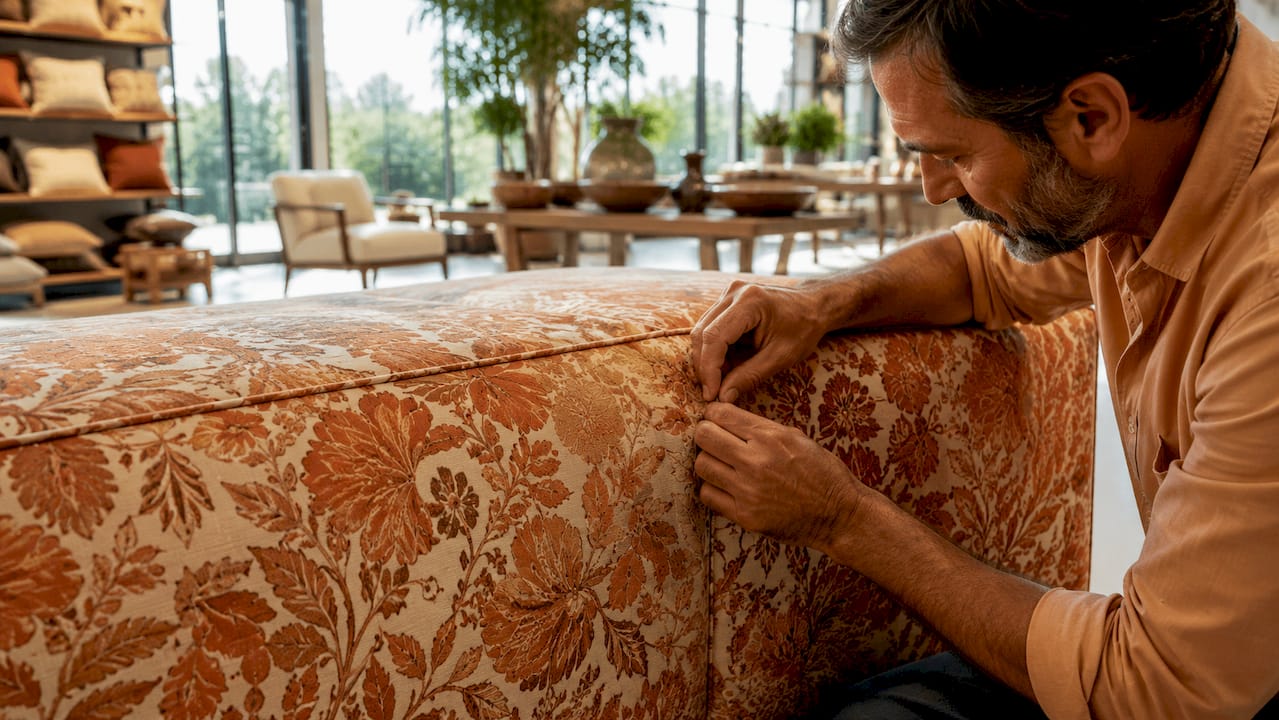
Pattern matching fabrics require more yardage and more labor. Both costs are real and should be communicated clearly before a project begins. The reward is furniture that looks like a finished composition rather than a collection of cut pieces.
How does pattern repeat and fabric nap impact upholstery pattern matching?
Pattern repeat is the distance, measured vertically and horizontally, before a fabric design begins to repeat itself. Larger vertical repeats require more yardage because each cut must start at the same point in the repeat, causing unavoidable waste between panels. A fabric with a 24-inch vertical repeat forces every new panel cut to begin at the same motif position, regardless of how much fabric sits between cuts.
Straight match vs. half-drop match
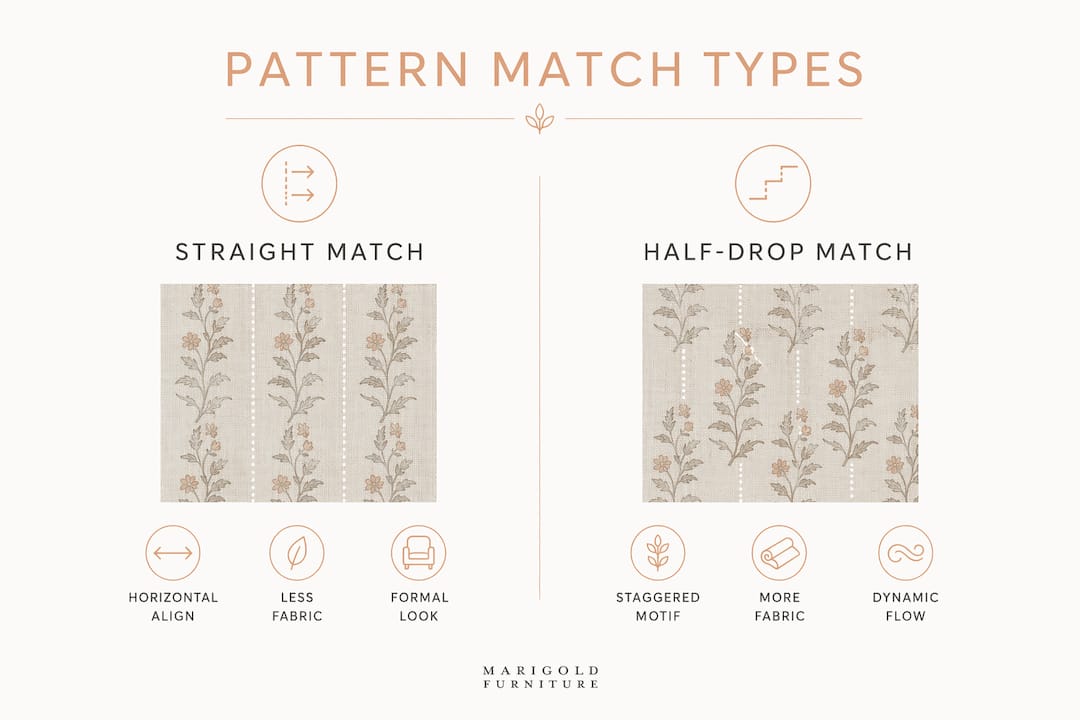
The two primary upholstery pattern types are the straight match and the half-drop match. Each behaves differently on the bolt and on the furniture.
| Match Type | How it works | Yardage impact |
|---|---|---|
| Straight match (set match) | Pattern lines up horizontally across seams with no vertical offset | Requires one full extra vertical repeat per cut piece |
| Half-drop match | Alternate widths are offset by half the vertical repeat, creating a staggered look | Requires 1.5 vertical repeats per cut length; roughly 15–20% more waste |
Straight match is simpler to execute and wastes less fabric. Half-drop layouts produce a more dynamic, flowing visual but carry a real cost penalty. For large repeat fabrics, such as a 27-inch jacquard, fabric yardage can increase by 30–50% compared to a solid fabric. That number should appear as a separate line item in any professional quote.
Nap direction and color consistency
Nap refers to the raised surface texture on fabrics like velvet, chenille, and mohair. Nap direction affects color and appearance under light, making consistent nap direction across all panels non-negotiable. Cut one panel with nap running up and the adjacent panel with nap running down, and the two pieces will read as different shades even from across the room.
Upholsterers mark nap direction on every cut piece before moving to the next. This simple habit prevents one of the most common and most visible errors in upholstery work. Maintaining nap direction ensures color consistency and prevents unintended visual mismatches in directional fabrics.
- Mark nap direction with chalk arrows on the back of every cut panel.
- Always cut all pieces for one furniture zone before moving to the next.
- Store cut pieces face-down in labeled stacks to preserve orientation.
Pro Tip: Before cutting any directional fabric, hold a single panel up to natural light and flip it 180 degrees. If the color shifts, you are working with a nap fabric and every cut must run the same direction.
What visual hierarchy and control line strategies guide pattern matching decisions?
Visual hierarchy is the decision about which motifs matter most and where they must land on the finished piece. Upholsterers lock in a control line before cutting, marking key visual reference points such as center lines, repeats, and nap direction to maintain pattern integrity during assembly. The control line is typically the vertical centerline of the most prominent panel, such as the outside sofa back.
Once the control line is set, every subsequent panel is planned in relation to it. The goal is to place the hero motif, the largest or most visually striking element of the pattern, at the optical center of the most visible surface. On a sofa, that surface is almost always the outside back, followed by the seat cushion fronts.
Good pattern alignment is judged from the usual viewing position, focusing on the seating area and primary visible faces, not from close-up or flat table views. This distinction matters because it gives upholsterers permission to accept minor mismatches in low-visibility zones, such as the underside of an arm or the inside of a tight curve, without compromising the overall result.
Acceptable compromises include:
- Pattern breaks at the back of the seat cushion where it meets the sofa back.
- Slight mismatches along the underside of rolled arms.
- Offset patterns at welt cord seams on complex curves.
Pro Tip: Stand six feet back from the piece and squint. If the pattern reads as intentional and continuous from that distance, the alignment is working. Close-up perfection is a bonus, not the standard.
The control line strategy also guides centering decisions. Centering large motifs on visible panels like sofa backs increases fabric use, often adding 1.5 to 2.5 yards for large repeats compared to rail-to-rail placement. That extra yardage is worth every inch when the finished piece anchors a room with confidence.
How do different upholstery pattern matching types compare and affect fabric usage?
Choosing between pattern matching approaches is both a design decision and a budget decision. The visual effect you want determines the method, and the method determines the cost.
-
Straight match, centered placement. The pattern is centered on each panel and matched horizontally across seams. This is the most common approach for floral and medallion fabrics. It produces a symmetrical, formal look and wastes the least fabric of any matching method.
-
Straight match, rail-to-rail placement. The pattern is not centered; instead, it runs from one edge of the panel to the other wherever it falls. This method saves yardage but sacrifices the visual balance that centering provides. Use it on side panels and low-visibility zones.
-
Half-drop match, centered placement. The most demanding approach. Each alternate width is offset by half the vertical repeat, and the motif is still centered on primary panels. This method requires the most planning, the most yardage, and produces the most dynamic visual result.
-
Half-drop match, rail-to-rail placement. A practical middle ground for complex patterns on secondary panels. The staggered layout reads as intentional without the full yardage penalty of centered half-drop work.
Half-drop pattern waste results not only from larger repeats but because adjacent fabric widths must start at differing repeat points. A practical workaround is applying a 15–20% multiplier to straight-match estimates when planning half-drop yardage. For a project that would need 12 yards on a straight match, budget 14 to 15 yards for a half-drop layout.
| Approach | Visual effect | Relative fabric cost |
|---|---|---|
| Straight match, centered | Formal, symmetrical | Moderate |
| Straight match, rail-to-rail | Casual, economical | Low |
| Half-drop, centered | Dynamic, artisanal | High |
| Half-drop, rail-to-rail | Flowing, balanced | Moderate to high |
What are best practices for executing pattern matching in upholstery projects?
Pattern matching is a pre-cut decision process where upholsterers decide motif hierarchy and repeat locks before any fabric is cut. Adjustments after cutting are limited. This planning prevents pattern drift and reduces waste across a multi-panel project.
The most reliable method is a zone-by-zone cutting strategy. Cutting the most visible reference panel first, such as the sofa’s outside back, and then computing offsets for subsequent panels prevents cumulative pattern drift across multiple zones. Each zone is planned from the reference cut, not from the bolt edge.
Best practices for clean execution:
- Lay the full fabric bolt flat and mark all repeat points before touching scissors.
- Cut the outside back panel first; use it as the master reference for all other panels.
- Label every cut piece with its zone name and nap direction before stacking.
- Use a zone-by-zone approach rather than a flat buffer to optimize fabric use and pattern continuity.
- Check alignment by pinning adjacent panels together and holding them up to light before sewing.
Common mistakes include starting cuts from the selvage edge without checking repeat position, mixing nap directions in a rush to save fabric, and failing to account for seam allowances when planning repeat locks. Each error compounds across panels, and by the time the piece is assembled, the drift is visible and irreversible.
Pro Tip: Photograph the fabric bolt at the start of every project with a ruler in frame. This gives you a permanent reference for repeat measurements and motif positions if you need to order additional yardage mid-project.
Pattern matching as craft, not just calculation
Pattern matching upholstery is less about achieving mathematical perfection everywhere and more about making intentional choices that serve the finished piece. After years of working with floral and chintz fabrics, I have come to believe that the most skilled upholsterers are not the ones who never compromise. They are the ones who know exactly where to compromise and why.
The conversation with a client about yardage and labor is where this craft gets real. A bold floral with a 24-inch repeat on a tufted sofa back is a beautiful idea. It is also a project that requires honest communication about cost before the fabric is ordered. Clients who understand why pattern matching adds yardage and time tend to value the result far more than those who are surprised by the invoice.
The trend toward bold, large-scale patterns in upholstery fabrics is accelerating. Chintz, jacquard, and printed linen are all having a genuine moment in interior design. That trend makes pattern matching skills more visible and more valued than ever. A sofa with a perfectly centered peony motif, continued across every cushion and panel, is not just furniture. It is a statement about the maker’s care and the owner’s taste.
— Kevin O’Gara
Marigold Furniture’s handcrafted floral sofas
Marigold Furniture brings pattern matching upholstery to life across a collection of handcrafted floral sofas built in Dallas and Los Angeles. Every piece is benchmade with over 20 chintz and floral fabric choices, and each sofa is cut with the same control line discipline described in this guide.
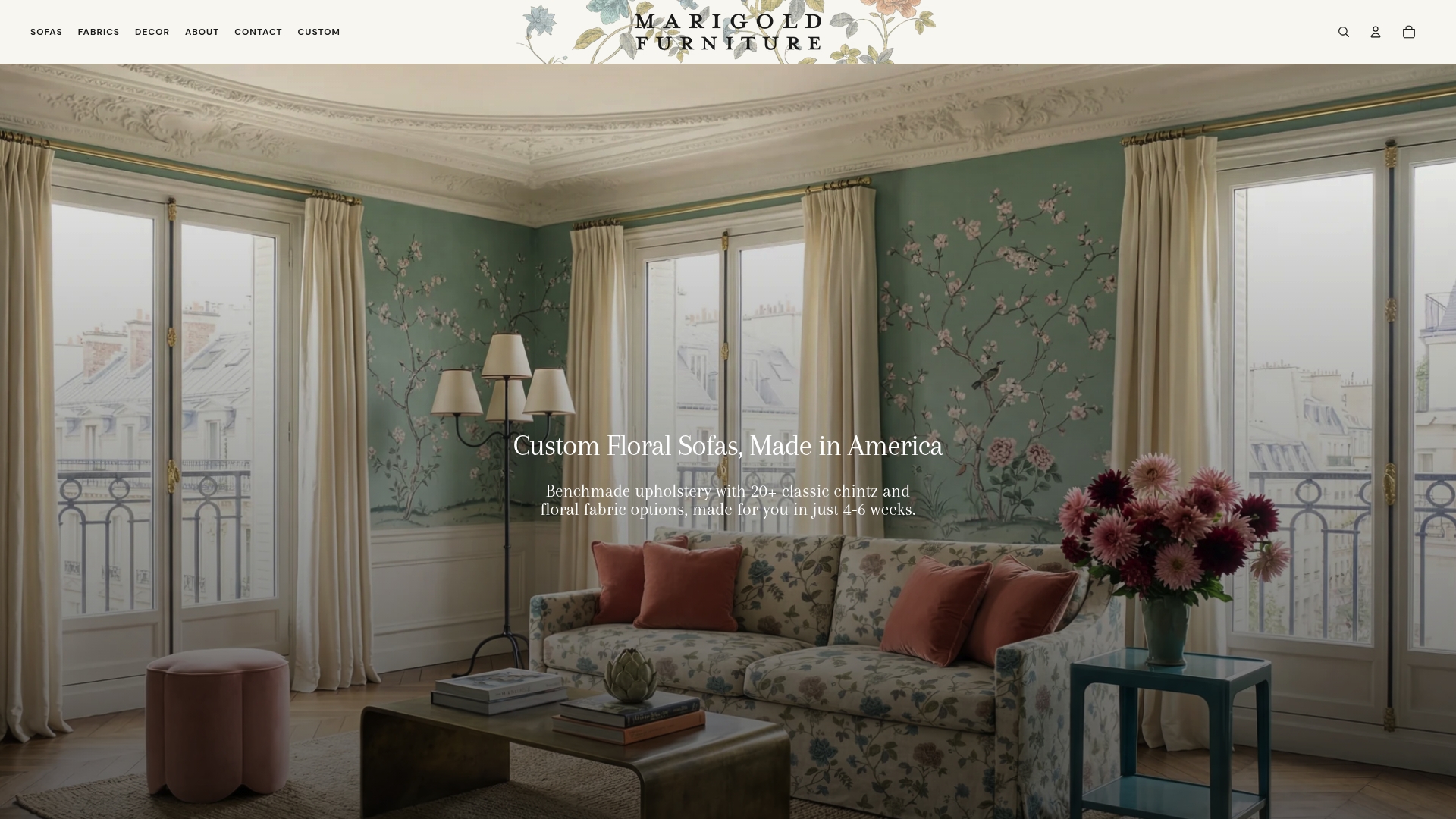
The Florence Arched Floral Sofa and the Seville Tufted-Back Floral Sofa both demonstrate centered motif placement across back panels and seat cushions, with nap direction maintained throughout. Made-to-order pieces ship in 4–6 weeks. For designers and homeowners who want a custom floral sofa design with fabric and pattern placement tailored to a specific room, Marigold Furniture offers personalized consultations to guide every decision from bolt to finished piece.
FAQ
What is pattern matching upholstery?
Pattern matching upholstery is the practice of cutting and aligning patterned fabric so the design continues without interruption across all visible seams and panels. It requires planning repeat positions and nap direction before any fabric is cut.
How much extra fabric does pattern matching require?
Large repeat fabrics can require a 30–50% increase in yardage compared to solid fabrics. Half-drop layouts add roughly 15–20% more waste on top of straight-match estimates.
What is the difference between a straight match and a half-drop match?
A straight match aligns the pattern horizontally across seams with no vertical offset. A half-drop match staggers alternate widths by half the vertical repeat, creating a more dynamic look but requiring significantly more fabric.
Why does nap direction matter in upholstery?
Nap direction affects how light reflects off directional fabrics like velvet and chenille. Panels cut with inconsistent nap direction appear as different shades when the piece is assembled, even if the fabric color is identical.
Where should pattern alignment be prioritized on a sofa?
The outside back and seat cushion fronts are the highest-priority zones for pattern alignment, as they are viewed most directly. Minor mismatches on low-visibility areas like arm undersides are acceptable trade-offs in professional upholstery work.
Key takeaways
Pattern matching upholstery requires pre-cut planning, a clear visual hierarchy, and consistent nap direction to produce furniture that reads as a single, intentional composition.
| Point | Details |
|---|---|
| Define the control line first | Mark the centerline and hero motif position before cutting any panel to prevent pattern drift. |
| Budget for repeat waste | Large repeat fabrics add 30–50% more yardage; half-drop layouts add 15–20% on top of straight-match estimates. |
| Cut the reference panel first | Start with the most visible panel, such as the outside back, and plan all other cuts from that reference. |
| Maintain consistent nap direction | Mark nap direction on every cut piece to prevent directional fabrics from reading as mismatched shades. |
| Judge alignment from viewing distance | Assess pattern quality from six feet away at seated eye level, not from close-up or flat on a table. |